Precision Fine Blanking
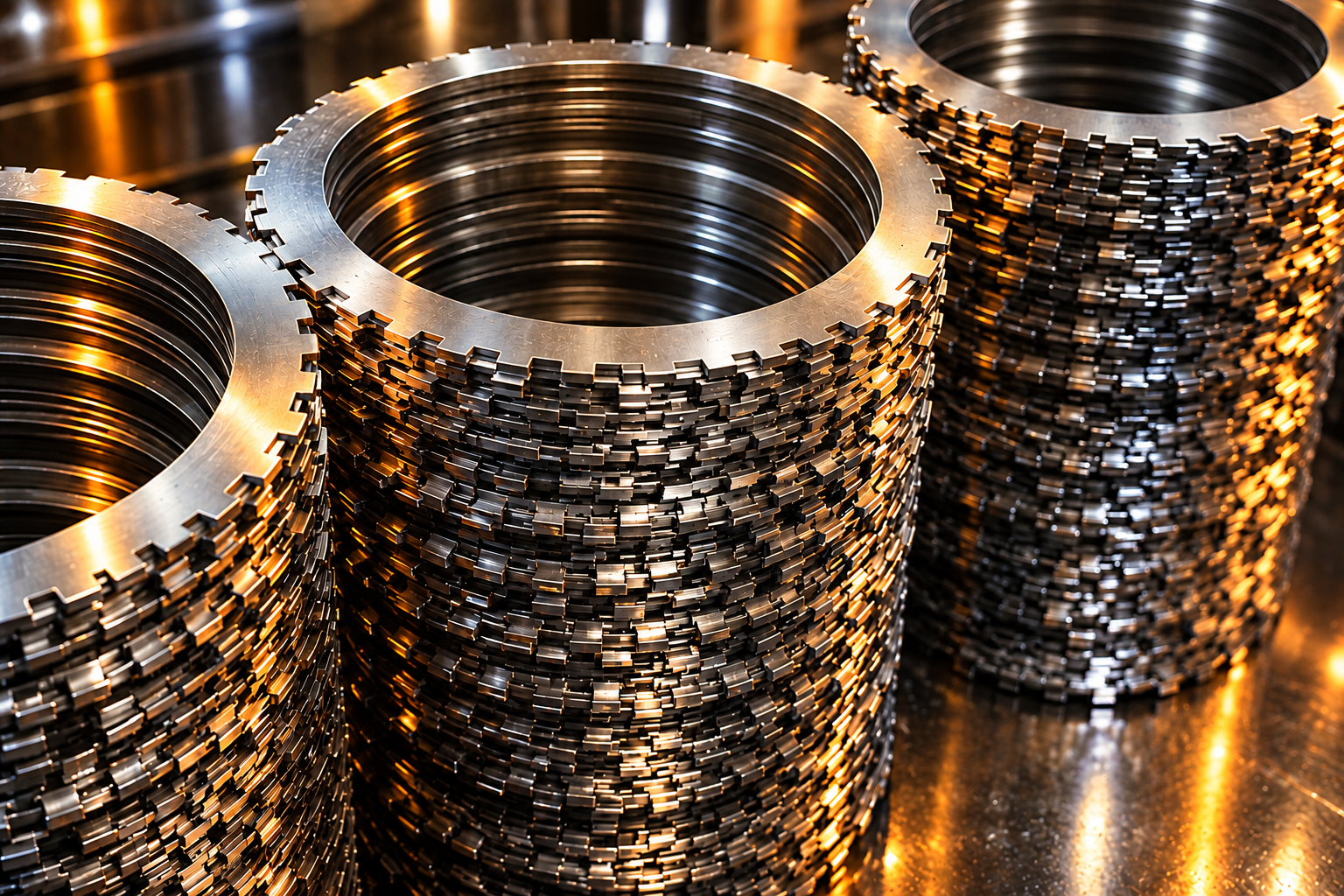
Fine blanking is at the core of what Burkland does. It is a precision metal-forming process used to produce components with clean edges, accurate features, and consistent geometry.
For the right part, fine blanking can provide a more efficient path to production than conventional stamping or extensive secondary machining. It is especially useful when the component requires close attention to edge condition, flatness, perpendicularity, dimensional accuracy, and repeatable results.
What Makes Fine Blanking Different?
Fine blanking is more than conventional stamping with tighter tolerances. The process is designed to control the material throughout the cut, producing a clean, fully sheared edge rather than the rougher edge condition often associated with conventional stamping.
That difference can matter when the edge is part of the function of the component. Parts that need to fit closely, move smoothly, engage another part, or maintain a precise shape may benefit from the cleaner edge and controlled geometry fine blanking can provide.
When Fine Blanking May Be the Right Choice
Fine blanking is worth considering when a component has requirements that conventional stamping may not consistently meet. It can be a strong option for parts with thicker material, tight tolerances, critical flatness, precise edges, or features that need to remain perpendicular to the part surface.
The best process depends on more than the shape of the part. Material type and thickness, production volume, critical features, inspection requirements, and how the component will perform in the final assembly all need to be considered.
Burkland begins by looking at the drawing and the requirements behind it. That helps determine whether fine blanking is the right process or whether another approach may make more sense for the program.
Clean Edges and Accurate Features
One of the primary advantages of fine blanking is edge quality. Fine blanked parts can have smooth, fully sheared edges that often require less secondary finishing than parts produced through conventional stamping.
This can be important for components with functional edges, internal openings, gear-like features, locking surfaces, or areas that must contact, guide, or engage another component. A clean edge can help improve fit, reduce additional processing, and support more consistent performance.
Flatness, Perpendicularity, and Consistency
Many parts need more than an accurate outline. They may need to remain flat, maintain a close relationship between the edge and the surface, or meet dimensional requirements across ongoing production volumes.
Fine blanking is well suited to applications where flatness, perpendicularity, and dimensional accuracy are important. Burkland evaluates these requirements early so the tooling and production process can be aligned with the needs of the finished component.
Tooling Makes a Difference
Fine blanking performance depends heavily on the tooling behind the process. Burkland designs, builds, and maintains tooling in-house, which creates a direct connection between the people responsible for the tooling and the people producing the parts.
That connection supports better communication, practical problem-solving, and ongoing attention to the details that affect part quality and production consistency. It also helps Burkland support new programs, ongoing production, tooling maintenance, and process improvements as needs change.
Applications Across Demanding Industries
Fine blanking can be used in a wide range of industries where precision metal components need to perform reliably. Burkland supports applications in automotive, heavy truck, industrial equipment, agriculture, construction, defense, consumer products, and specialty markets.
Previous Burkland materials identify examples involving transmission and shifting components, steering hardware, seating mechanisms, door and lock hardware, latches, gears, engine-management parts, couplers, and bicycle-related components. These examples show the range of applications that can benefit from a precision-focused manufacturing approach.
Start With Your Part Requirements
The best way to determine whether fine blanking is right for your component is to start with the details. A drawing, material specifications, expected volume, timing, and information about critical features give Burkland a clearer picture of what the part needs to do.
If edge condition, flatness, perpendicularity, dimensional accuracy, material thickness, or reduced secondary operations are important to your program, fine blanking may be worth evaluating.